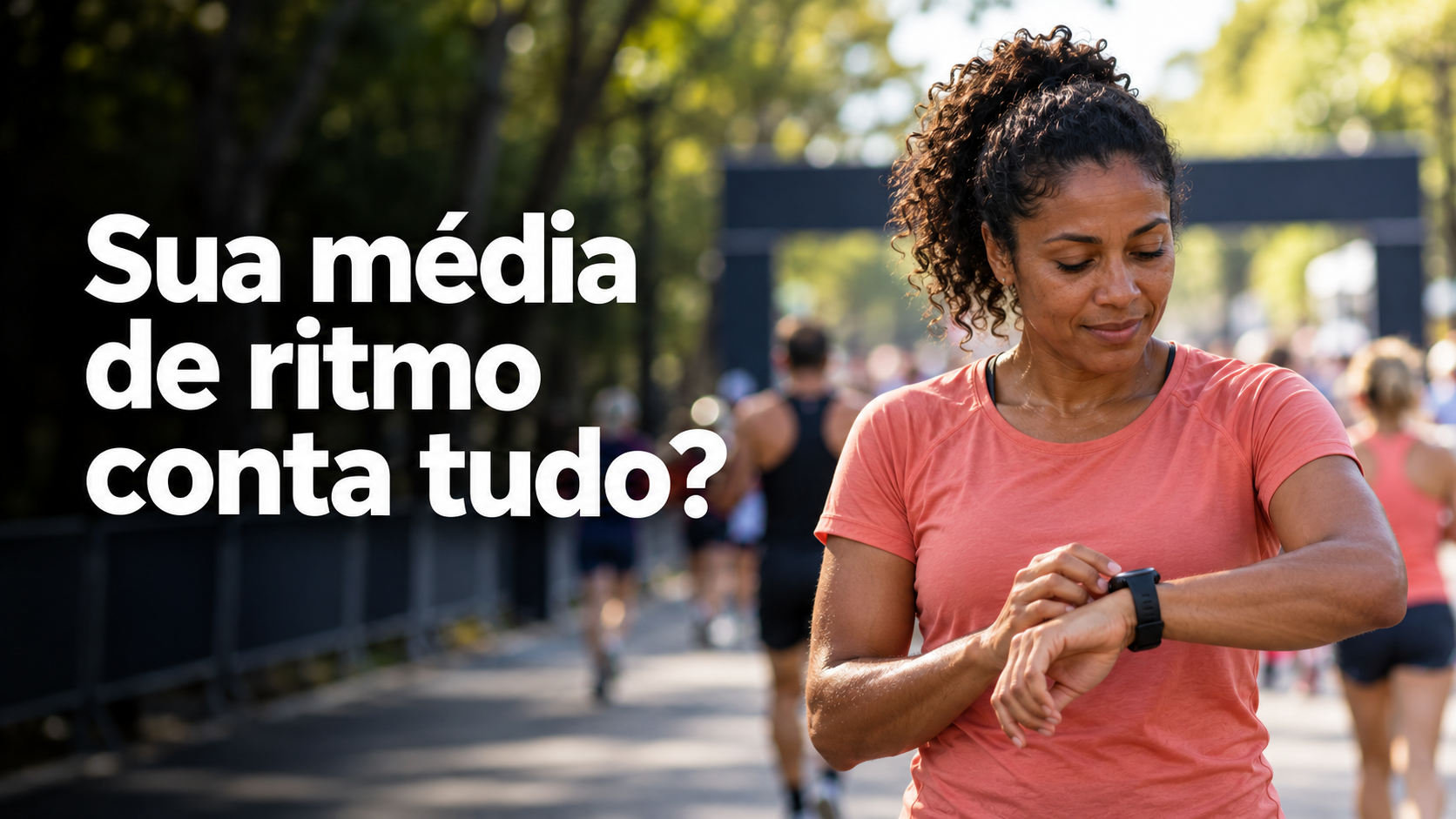
Crowded start: do I need to make up the lost seconds?
Did your race start slower than planned? Check space, effort and strategy before trying to win back the seconds you lost at the start.

Were the first few meters slower than planned? Before you speed up, look at the space, the effort and the strategy you prepared.
You cross the start line but still can't run the way you pictured. There are people ahead of you, the pack inches forward and a turn squeezes runners together. When an opening appears, you feel the urge to speed up and win back the time.
That reaction deserves a pause. Starting slower than your planned pace doesn't, on its own, determine what to do on the next stretch.
A congested start calls for adapting. It doesn't create an automatic obligation to make up every second.
For beginners and recreational runners in the 5 and 10 km, the decision depends on the training you've done, your goal for the race and the course conditions. Those running a half marathon or marathon also need to think about how to spread their effort over a much longer time.
The problem isn't just the clock
When the start doesn't go as planned, you can end up running to make up for a delay, pushing what's happening around you into the background.
Picture an illustrative scenario: the path opens up for a few meters and you speed up; right after, you run into another group and have to slow down. You try again farther on. The idea was to settle into your pace, but the execution turned into a string of reactions.
In the official London Marathon guide, the advice for the early stages is to avoid weaving and going too fast on the downhill, staying patient to find your pace. It's a recommendation from that event, useful for thinking about how to behave at a crowded start — not a formula for every race. London Marathon Events
The practical takeaway here is a general recommendation: before using an opening to speed up, check whether it lets you pass safely and keep moving smoothly.
Making up time changes the demand
Running faster to make up for a slow stretch changes what you're asking of your body at that moment. That doesn't mean every surge is a bad idea. It means the decision needs context.
An experienced runner may have a strategy worked out with their coach. Someone running their first race may simply aim to finish, alternating walking and running according to their training.
The two situations don't call for the same response.
There's also no universal number of seconds that can be recovered, nor a set distance to close the gap. This article doesn't suggest speeding up by a certain percentage or running the next kilometer in a specific time.
If your goal depends on a big change in execution, you may need to rethink your expectations. A time goal doesn't erase the limits of space or the conditions of the day.
What the research helps us understand
How you distribute your speed over a race is usually called pacing, or pacing strategy.
Swain, Biggins and Gordon studied 139 participants using questionnaires on training and experience, matched to their splits from a 2017 marathon. They found associations between preparation characteristics, experience and the ability to hold pace. Wiley Online Library
The study was published online in November 2019, in the August 2020 issue. For this article, we consulted the abstract made available by the publisher.
These are marathon data from a correlational analysis. They don't show that a congested start causes a loss of performance, nor do they test a way to make up seconds. They also don't justify carrying a 42 km strategy directly over to 5 km.
Its contribution to this conversation is more limited: how you distribute your pace deserves attention alongside your running history. A race-day decision shouldn't rest only on the urge to correct your first split.
When the path opens up, check three things
As general execution guidance, run a quick check.
Space: is there enough room to pass, within the permitted course, without bumping anyone or forcing another runner to change direction abruptly?
Effort: how does the run feel at that moment? Perceived exertion is your subjective assessment of how much the activity is demanding of you. It adds context but doesn't replace a medical evaluation or individual guidance.
Plan: are you getting back to a strategy you prepared, or inventing a new one to erase the delay?
These questions don't define an ideal pace. They help keep frustration over the start from making the decision on its own.
If you trained alternating walking and running, stick with that approach. What the person next to you is doing doesn't tell you which strategy fits your preparation.
Sharing the course is a skill too
There are participants running, walking, passing or looking for help. The experience depends on predictable movements.
The Fox Cities Marathon etiquette guide advises calling out when passing, staying aware of your surroundings and moving to the side when you need to stop. It also stresses making way for emergency crews and wheelchair athletes. Running Etiquette
That race's guidance on which side to keep to includes trail sections. It isn't an automatic rule for Brazilian events. Check the rules, the signage and the organizers' instructions.
As general courtesy, avoid cutting off someone you've just passed. Before slowing down or changing direction, look at who's coming up behind you and signal your intention when possible. Don't block the space set aside for medical care or emergency access.
Walking doesn't have to be a source of embarrassment. What matters is how each person shares the course, regardless of their speed.
Each distance calls for its own conversation
In the 5 and 10 km, the start can make up a significant share of the experience, but that doesn't mean newer runners have to surge abruptly.
In the half marathon and marathon, there are still many kilometers to go after the start. Adjustments should take into account your training and your goal for the whole race.
For advanced and professional runners, battles for position and tactical decisions require a different analysis. The guidance in this article doesn't replace an individual race plan.
At any distance, trouble moving through the field calls for attention to space. Worrying symptoms or feeling unwell call for medical help, not an attempt to correct your pace.
Plan your response before the next start
One useful step is to bring this question to your coach: “If the start gets congested, how should I adjust my strategy?”
If you use a general program, check its guidance and the race information. Respect your assigned start corral; when you can choose based on a time estimate, use a prediction that matches your training.
After the event, write down what happened and how you reacted. That helps you tell a course limitation apart from a decision driven by anxiety.
In your next race, check space, effort and plan when the path opens up. Your first split is information for the decision. It doesn't have to run your whole experience.
Educational content, not an individual pacing prescription or competitive strategy. Follow the organizers' instructions and seek out the medical team if you feel unwell or have worrying symptoms.
Celio Bernardi
 Sport connects stories.